Tower Rush - Is it really worth the money?
Tower Rush Review: Is the game really worth it?
I have taken on Tower Rush over several weeks — demo and real money, smartphone and desktop, various strategies and betting levels. This review investigates the most common claims and examines where Tower Rush actually delivers and where reality falls short of the marketing.
Tower Rush delivers in most areas it promises. The game mechanics work, the RTP is correct, and the active component sets it apart from passive crash games. The weaknesses lie in long-term entertainment value and missing comfort features.
Claim No. 1: "Tower Rush gives the player real control"
Result: True — with limitations.
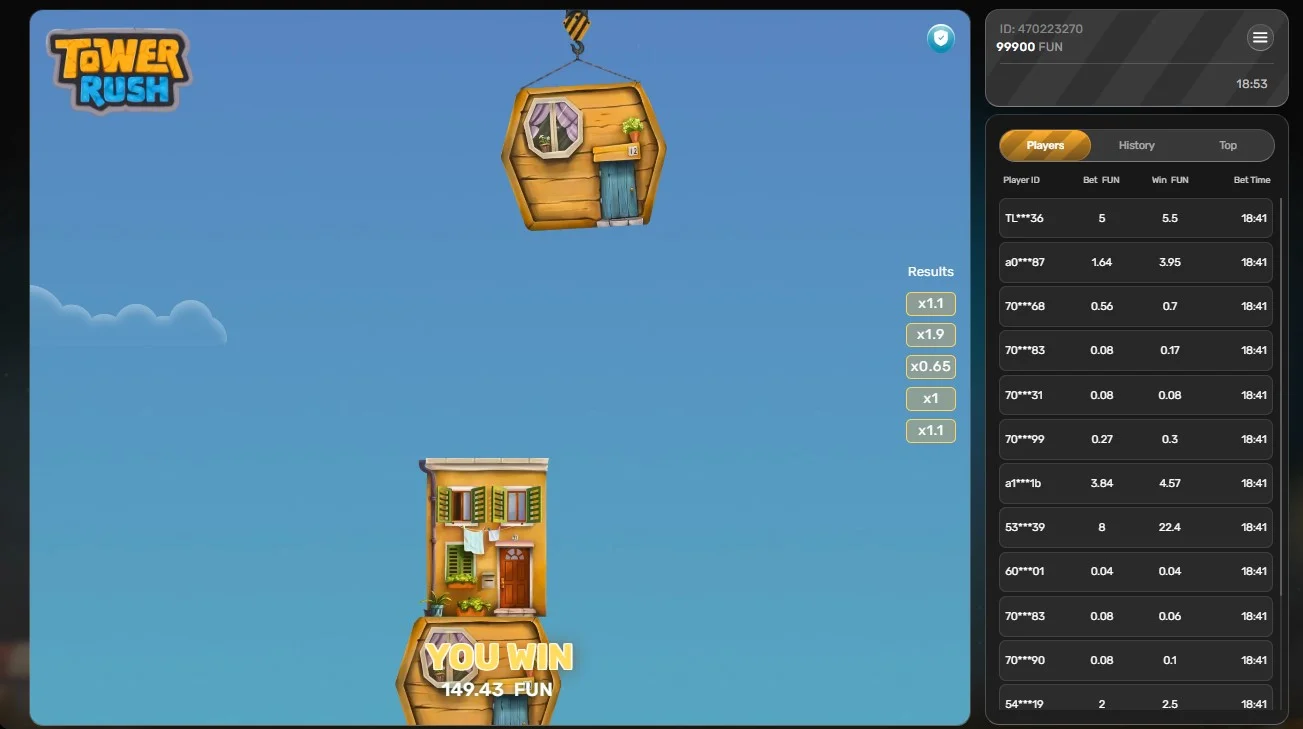
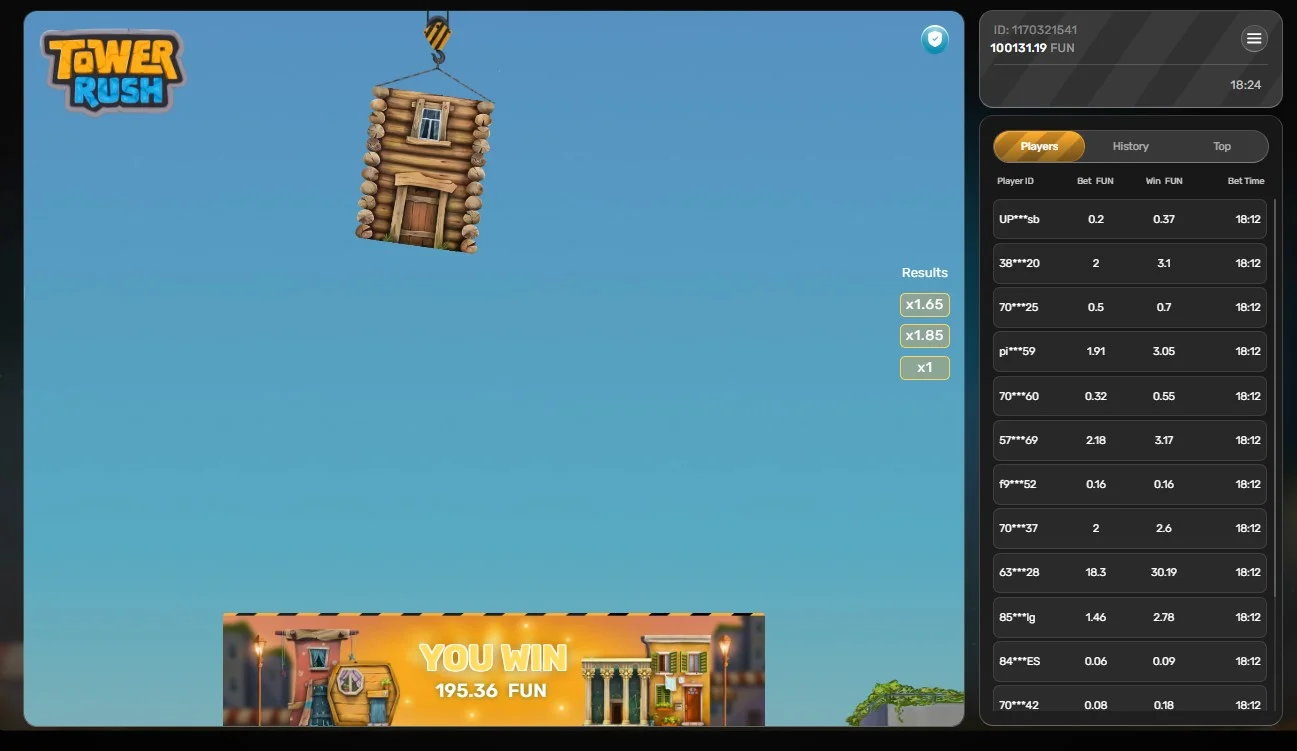
The control in Tower Rush is more real than in most crash games. You not only decide when to cash out, but also whether you hit the next block. The timing of the placement is entirely up to you. In games like Aviator or Spaceman, your only decision is the cashout timing. Here, a manual skill level is added.
The limitation: The random number generator still determines the framework. The swinging motion of the block, the speed changes at higher levels — all of this is subject to the RNG. You influence the execution, not the basic conditions. The game is honest in combining both, but "full control" would be an exaggeration. More accurately: you have more influence than in any other crash game I know.
Claim No. 2: "The RTP is above the industry average"
Result: True.
Tower Rush states an RTP of 96.12% to 97%. I compared this against other popular crash games:
| Game | RTP | Type |
|---|---|---|
| Tower Rush | 96,12-97 % | Crash game with building mechanics |
| Aviator | 97 % | Passive Crash Game |
| Spaceman | 96,5 % | Passive Crash Game |
| Average Turbo Slots | 94-96 % | Various Formats |
Tower Rush is thus in the upper half of the segment. Not the highest RTP on the market — Aviator is marginally higher — but clearly above what most turbo games and slots offer. For a game with an active skill component, the value is solid.
What you need to keep in mind: RTP is a long-term statistic. In a 20-minute session, you won't experience a 97.1% payout — you experience variance. Sometimes more, sometimes less. This is due to the high volatility that is part of the game design.
Claim No. 3: "The demo is identical to the real money game"
Result: True — as far as verifiable.
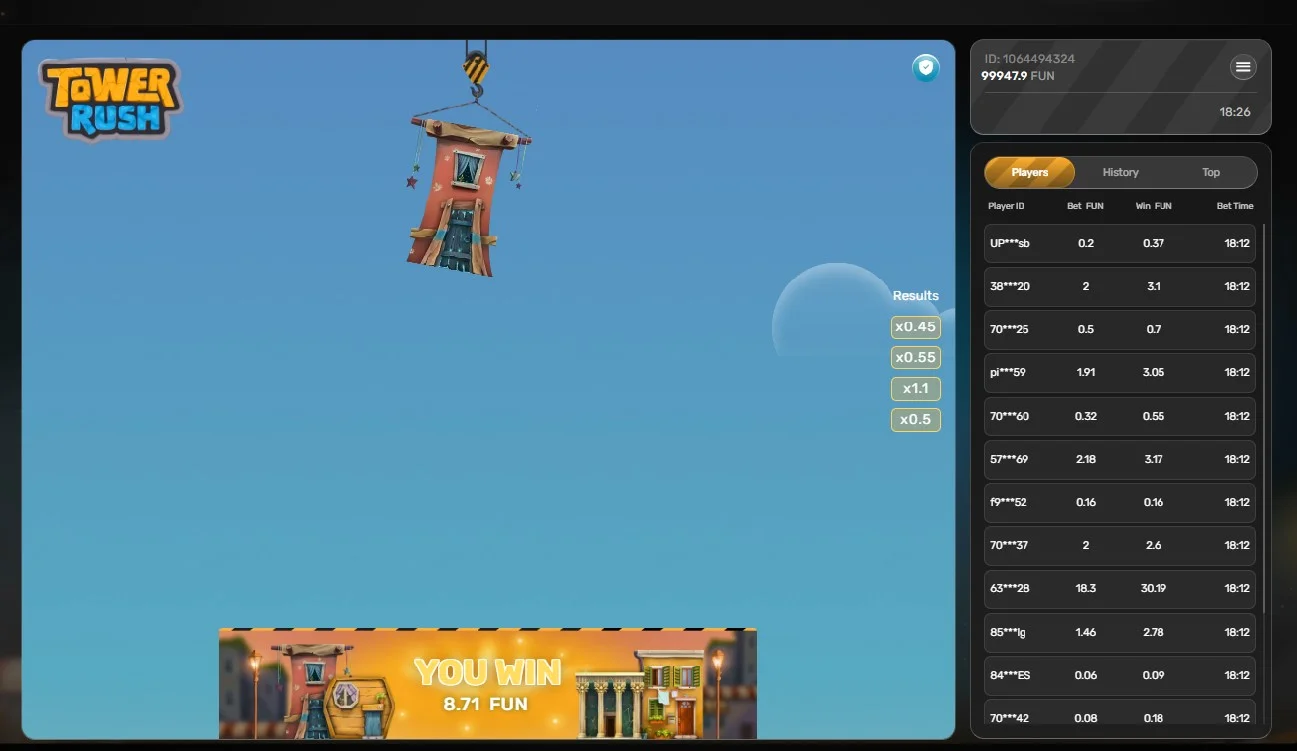
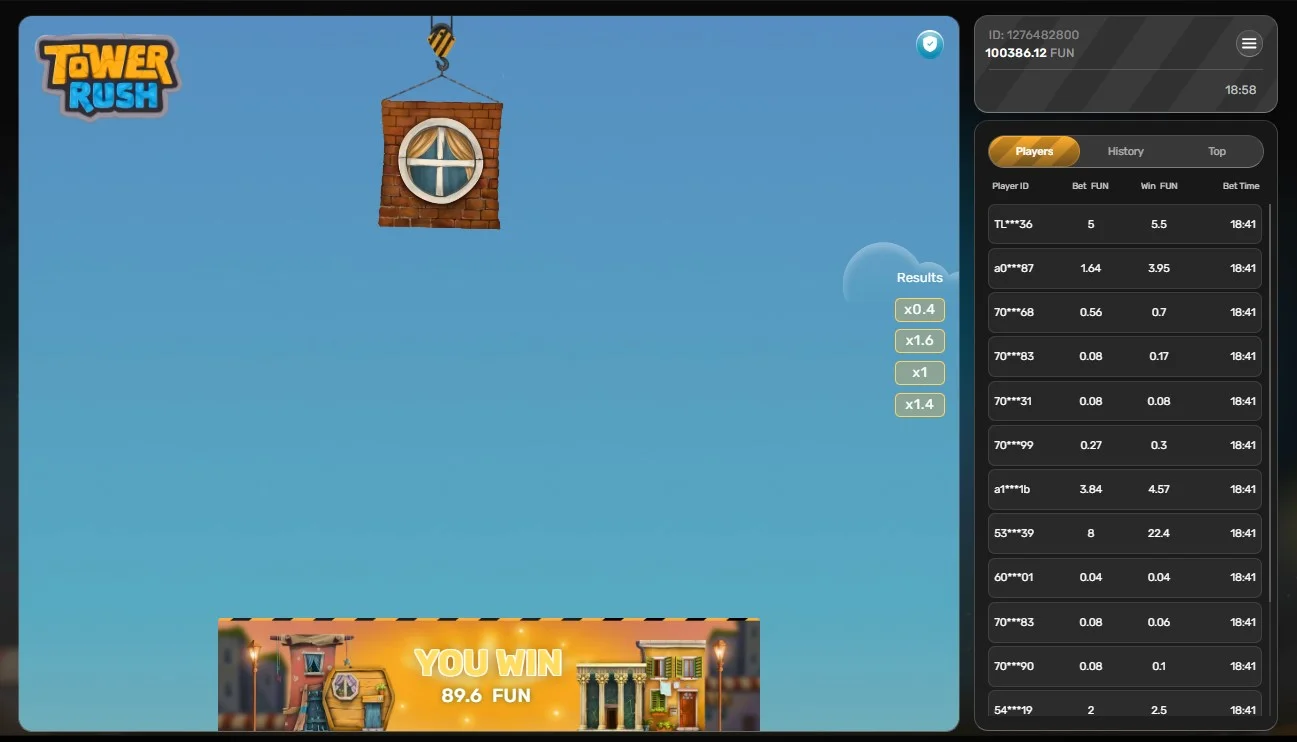
I extensively used the demo before playing with real money. The mechanics feel identical: same block movements, same multiplier progression, same bonus frequency. The three special features (Frozen Floor, Temple Floor, Triple Build) appear in the demo just as they do in real money mode.
What I cannot independently verify: whether the RNG in demo mode uses exactly the same algorithm as in real money mode. Galaxsys claims this, and the Provably Fair technology supports this statement. My subjective impression after hundreds of rounds in both modes: no discernible difference in gameplay behavior.
What the demo really offers: It is the best way to calibrate your timing and develop a cashout plan before real money is at stake. From a learning effect perspective, 30-40 demo rounds are worth their weight in gold.
Claim No. 4: "The bonus features change the game"
Result: Partially. Frozen Floor yes, the others less so.
Three bonus features, each a maximum of once per session. Sounds promising at first. In practice, it looks more nuanced:
Frozen Floor actually changes the dynamics of a round. From the moment your multiplier is frozen, your entire risk calculation changes. You can build more boldly because the worst-case scenario is no longer a total loss. This is a real strategic element — not just decoration.
Temple Floor is nice, but not game-changing. A random multiplier boost that you have no control over. Sometimes it helps noticeably, sometimes hardly at all. No reason to play differently because of it.
Triple Build is the stylistically most elegant bonus — three automatic floors without risk. Strategically valuable, but like Temple Floor not frequent enough to build a gameplay on it.
My conclusion about the bonuses: Frozen Floor alone justifies the praise. The other two are welcome extras, but not game-changers. Overall: the bonus features are a plus, not a unique selling point.
What I noticed in four weeks of gameplay
Aside from the technical data, there are things that you only notice after some time. Here are the observations that are not mentioned in any product description:
Mental fatigue comes faster than expected. Tower Rush requires attention with every block. No autopilot possible. After 20 minutes, my concentration noticeably declines — I miss more often and impulsively change my cashout plan. The game is not made for long gaming sessions.
The difference between demo and real money is emotional, not mechanical. Same block, same movement, same tower — but with real money, every decision feels different. This may sound trivial, but it changes gameplay behavior. In the demo, I routinely went for x15. In real money mode, my actual average was x7. Psychology makes the difference.
On the smartphone, half a percent of precision is missing. No drama, but noticeable. On the desktop, I hit at floor ten or eleven more reliably than on the touchscreen. Those who primarily play mobile and exit conservatively at x5-x8 won't notice anything. Those aiming for x15+ should consider the desktop.
The best session is the short session. My most successful sessions lasted ten to fifteen minutes. Not thirty, not forty-five. Tower Rush rewards concentration, and that has a clear expiration date.
Discipline in cashing out pays off in the long run. Sounds like a platitude, but in practice, it is the crucial point. In the first days, I constantly threw my plan out the window — was at x7, wanted x10, and then lost the tower at x9. Since then, I set the target multiplier before the round and do not change it anymore. The temptation remains, but the result is noticeably better.
The frequency of bonuses fluctuates more than expected. On some days, two bonus features appear in eight rounds. On other days, I play thirty rounds without a single bonus. This is due to chance and is completely normal, but it can be frustrating when you are hoping for one. My advice: forget the bonuses completely when planning and be happy when one appears.
Experiences from the community
"I was skeptical because every new crash game claims to be different. Tower Rush is actually different. Not revolutionary, but the skill component is noticeably fun. My problem: I can hardly click straight after 20 minutes due to tension."
"The demo really helped me. I realized that my natural exit point is at x6, and since then I've been doing well with it. In real money, I rarely go higher. Better consistent small wins than big fluctuations."
"Frozen Floor at x9 — then just kept building up to x16. The feeling of having a safety net and still going up is the best part of this game. You won't find that in any other crash game."
"Great for ten minutes. After that, it becomes too monotonous for me. The graphics are clean, but not much new happens. Those who need variety won't stay here long."
"What surprised me: the payouts via e-wallet were faster than expected. The money was there in under six hours. I mainly like the game because of Frozen Floor — without this bonus, Tower Rush would be a normal crash game for me. With it, it becomes really interesting."
When Tower Rush is worth it — and when it isn't
Yes, definitely. The minimum bets start at €0.10, which allows for 50-100 rounds with a €10 budget. With a conservative cashout at x4-x6, the budget can be stretched over several sessions.
If you want more interaction — yes. Tower Rush gives you an element with block placement that Aviator doesn't have. If you prefer the passive format of Aviator and don't want to pay attention to precision, it's better to stay there.
Not really. The game is optimized for short, intense sessions. After 20-30 minutes, concentration wanes, and so does the quality of decisions. Those planning a long evening should include Tower Rush as one of several games — not as a continuous format.
For multipliers up to x10 — absolutely. The mobile version runs smoothly and the touch controls work well. At higher levels, the desktop offers a slight precision advantage.
The real money entry in brief
Those ready for real money after the demo need an account with a licensed casino. The key steps in a nutshell:
- Choose a casino with a valid license (MGA, Curaçao, Gibraltar) and check the license information in the footer.
- Complete registration — takes three to five minutes.
- Perform KYC verification immediately (ID + proof of address) to avoid later waiting times for withdrawals.
- Make the first deposit — card, e-wallet, or crypto, depending on preference.
- Start Tower Rush and begin with small bets (1-3 % of the session budget per round).
For withdrawals: e-wallets are the fastest (often under 24 hours), credit cards take two to five days, crypto is in between. The KYC check is only done once — afterwards, withdrawals are processed routinely.
Security and legal framework
Tower Rush uses a certified random number generator and provably fair technology. Galaxsys is licensed by international regulators and is represented on over a hundred platforms worldwide. The game is regularly audited by independent testing labs.
In Germany, the State Treaty on Gambling (GlüStV) applies. Tower Rush is accessible on international platforms with licenses from MGA, Curaçao, or Gibraltar. Reputable providers transparently display their license, use SSL encryption, and separate player funds from operating capital. The BZgA offers free and anonymous advice for players at 0800 1 37 27 00.
Final questions
Is Tower Rush manipulated?
How high can the multiplier go?
Do I need an app?
Can I test the bonus features in the demo?

Hannah Schneider
Senior iGaming Analyst & Expert in Crash Games
Final result: Is Tower Rush worth it?
The short answer: Yes, if you know what to expect from it.
Tower Rush is not a game for hours-long sessions. It is not a progressive jackpot machine. And it does not guarantee wins — just like no reputable casino game does. What it delivers: a crash game format with a real skill component, fair RTP, and a game mechanic that actively engages you instead of letting you watch.
The building mechanics work. The bonus features — especially Frozen Floor — add strategic depth. The demo is honest and helpful. The mobile version is decent. The weaknesses are real: visual monotony in long-term play, lack of auto cashout, and bonus features that occur too rarely to be predictable.
For short, focused gaming sessions with a clear budget? Tower Rush is among the best options in the current crash game offering.
My rating: 4.1 out of 5.
Responsible gaming: Tower Rush is a gambling product with an integrated house edge. Never play with money you need for other purposes. Set fixed budget and time limits and stick to them. If you have problems with gaming behavior: Federal Centre for Health Education (BZgA), phone 0800 1 37 27 00 (free and anonymous).